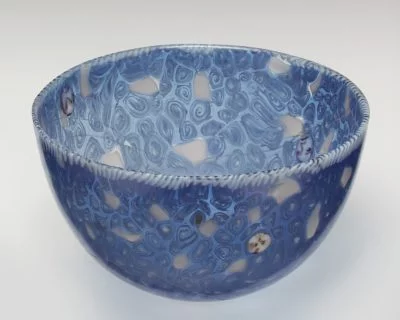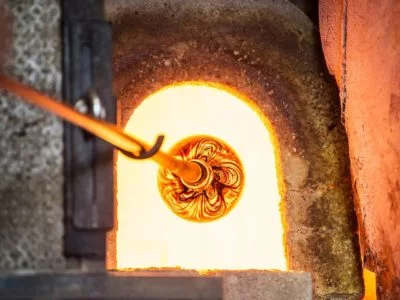

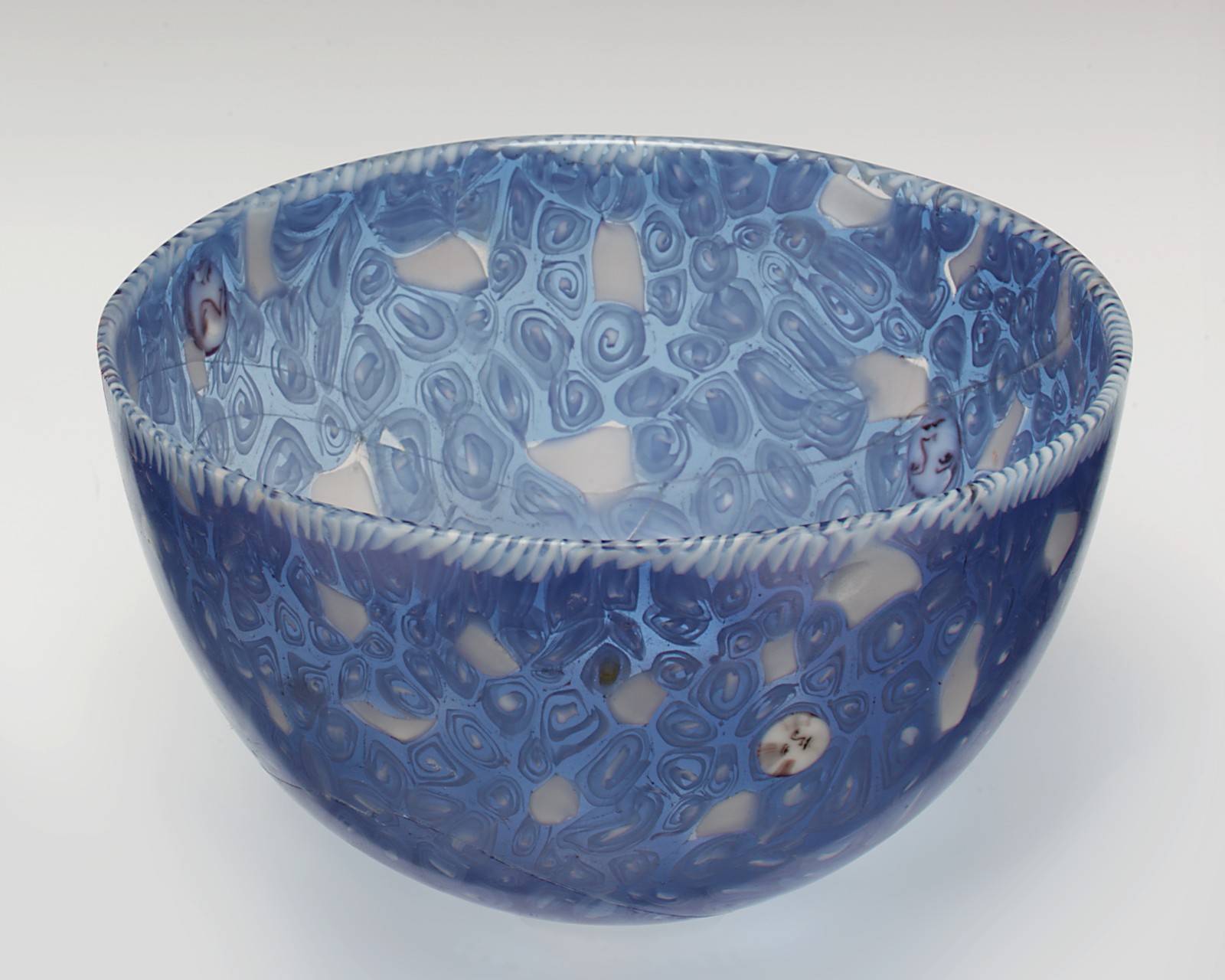
The 19th century saw a profound crisis in Murano, followed by an exceptional economic recovery, which occurred starting in the 1960s but of which there were some modest signs even in the previous twenty years. The production of the second half of the century reached a very remarkable technical level both in the field of copies of ancient types and in that of the original models, characterized in the best examples by a admirable softness of the model and a lively and refined polychrome. The same imitation of the ancient in Murano was dictated, in addition to the artistic canons of the time, by the deeply felt need to recover the local technological and cultural heritage, largely forgotten in the years of crisis, and was accompanied by a loving and careful study of the Murano products of the past.
With the fall of the Republic of San Marco in 1797, the glass crisis, delayed by appropriate initiatives during the 18th century, became definitive while the city and its territory saw a a democratic municipality lasting a few months in the same 1797, a first Austrian domination after the Treaty of Campoformio of 17 October 1797, the annexation to the Napoleonic Kingdom of Italy in 1806 and the Austrian Lombardy-Venetian Kingdom in 1814. Austria did not take a benevolent attitude towards the Murano glass industry. The raw materials and the same combustible wood, in fact, coming from abroad and mostly from countries of the Habsburg Empire, were burdened by heavy taxes.
The Charters of the Chamber of Commerce, kept in the Venetian State Archives, document repeated and accurate requests by Murano producers to the Austrian administration for more favorable conditions, Request only in a small part listen. This aggravated a situation already made difficult by the unfavorable attitude towards Venetian glass products on the European market, which in the neoclassical period showed a strong preference towards elegant and splendid English crystals and in the Biedermeier period towards richly engraved Bohemian crystals. It should also be remembered that entrepreneurs and workers faced the crisis in isolation and disorganized, having abolished the Arts in 1806, not replaced by other similar associations.
Even the production of confectionery, “the only branch of domestic industry ‘A’ Viniciani left”, was affected by the damage due to the entry duties for raw materials and the exit duties for the finished product, mostly intended for colonial countries. The artistic production was almost inconsistent, if we exclude the rather poor, colorless glass blows, with a crude decoration in white enamel of clear eighteenth-century ancestry or with polychrome enamels with reasons alluding to the various changes in the political regime suffered then by Venice.
Of little importance was the manufacture of colored vitreous plates, suitable for the inlay of furniture, for which Benedetto Barbaria stood out. As for the industrial revolution, the echo of it in Murano can only be heard in the glassworks of the Milanese “Fratelli Marietti”, founded in 1826 and dedicated to the production of common glass: plates, protective bells , wine bottles. In it, machines for the preparation of raw materials and charcoal ovens were adopted.
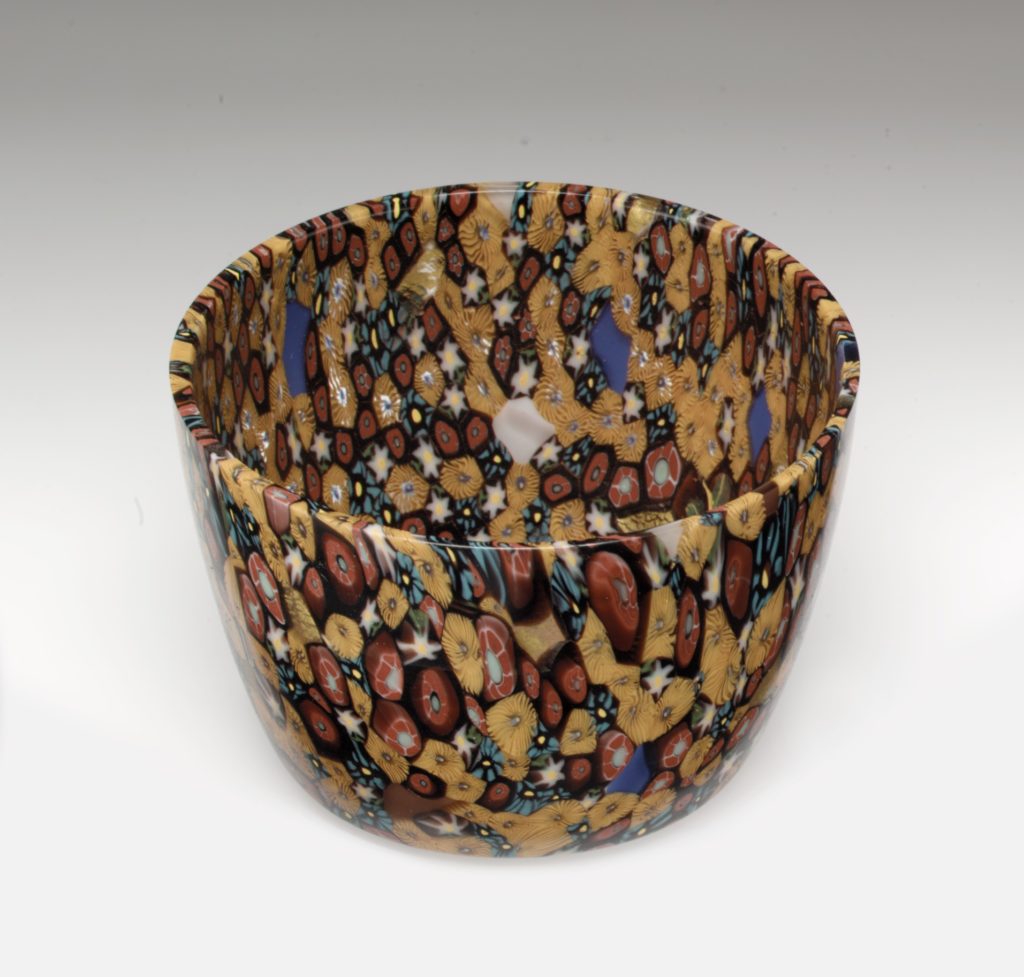
Around 1830, the taste changed again towards the Venetian style. Abroad, various products took up the ancient Venetian technique of filigree, while lovers of antiquity began to search for Murano glass. The Venetian antiquarian Antonio Sanquirico then had fakes made in the Murano kilns in filigree retrotoli, a technique that has since been referred to on the island also with a term derived from its name: “sapphire”.
In 1838 Domenico Bussolin resumed the processing of filigree glass, followed in 1845 by Pietro Bigaglia (1786-1876). No breath of Bussolin is known so far, while the Museum of Glass has a rich collection of Bigaglia watermarks, which reveal a variety of weaving and a richness of color, enhanced even more by simple shapes, typical of the Biedermeier.
For the first time, threads of aventurine are inserted in Pietro Bigaglia’s filigree fabrics, never remelted to be hot worked in previous centuries, of which he himself had rediscovered years earlier the processing technique. In 1856 Lorenzo Radi (1803-1874), an expert manufacturer of mosaic pastes, again succeeded in making chalcedony, a variegated paste similar to zoned agate of fifteenth-century invention. In the meantime, Giovanni Battista and Jacopo Franchini created vitreous canes by light containing in the miniaturism section portraits of people of the time and views of Venice. In general, however, these initiatives were not significant from an industrial point of view nor were they commercially lucky.
The most important initiatives for the Venetian glass revival were the creation in 1861 of a Muranese Glass Museum, understood as “a school where the artist and the technician come to study the antique glass”, and the following year of an adjoining drawing school for glassmakers.
The promoters of the initiative were Abbot Vincenzo Zanetti (1824-1883), a glass history scholar and first director of the museum, and Antonio Colleoni (1810-1885), mayor of the island. They intended to stimulate the people of Murano to recover ancient glass techniques and to reproduce the ancient models, according to the trends typical of the “revivals” era. For the same purpose, in 1867 a fortnightly magazine was founded, “La Voce di Murano – Journal of the Glass Industry”, which informed, in addition to the island news, on local and foreign news concerning glassmaking and which today constitutes a rich source of news on nineteenth-century Murano.
In 1854 the ‘Fratelli Toso’ started the production of common glass in their new company, and then soon specialized in artistic blowing. Antonio Salviati (1816-1890), a lawyer from Vicenza, who became a glass entrepreneur, chose “Salviati & C.” for the foundation of his glassworks. (since 1872 “The Venice and Murano Glass and Mosaic Company-Salviati & C.”) a uniquely favorable year, 1866, in which Veneto was politically united with Italy and was able to enjoy economic conditions and favorable financial.
A few months after the founding of the glassworks (already in 1859 he had created a mosaic art workshop, in which he used Lorenzo Radi’s vitreous pastes) he associated himself with English capitalists, including well-known English diplomat and archaeologist Sir Henry Layard, faithful to the traditional love of his compatriots for Venice. Salviati employed some of the best glassmakers of the time: the masters Antonio Seguso (1829-1903) and Giovanni Barovier (1839-1908), the young apprentices and then very skilled teachers Isidoro Seguso ( 1858-1896) and Giuseppe Barovier (1853-1942), the technical composers Luigi Dalla Venezia.
Andrea Rioda and Vincenzo Moretti (1835-1901). To the wide and in-depth expertise, entirely empirical, of the latter goes the credit for the wide chromatic range of the glasses and mosaics of the “Compagnia di Venezia e Murano”, for the creation of fine pastes stained glass such as “aventurine” and “chalcedony”, of the recovery of ancient and difficult decorative techniques.
In the early years of the Renaissance, Muranese glassmakers dedicated themselves to the reproduction of Venetian glass from the Renaissance and Baroque periods, in which the skill of their predecessors had been most expressed. in hot processing, based on the typical Muranese concept for which the artistic glass object should be appreciated if modeled and finished exclusively in a furnace.
The masters wanted to shape the ductile material, competing with the difficulties opposed to it and masterfully overcoming the ancient glassmakers. And in reality, in terms of technical perfection and virtuosity, nineteenth-century works often prove to be more appreciable than the original models, shaped with ease.
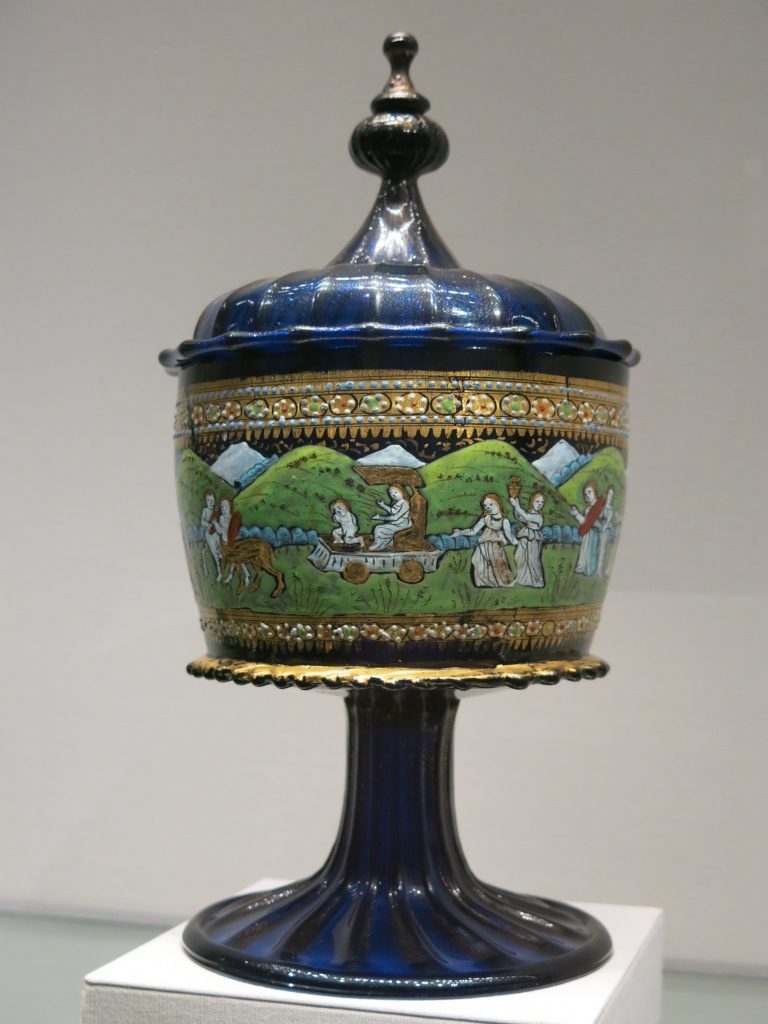
Furthermore, in drawing inspiration from the past, nineteenth-century glassmakers often devised variations rich in color and imagination, in which they ventured daring and previously unthinkable color combinations. The blowings presented by “Salviati & C.” at the Universal Exhibition in Paris in 1867 already stood out for the lively polychrome of the watermarks and the applied vitreous wires. In 1868, “The Voice of Murano” announced the creation, in Antonio Salviati’s firm, of “a new flame graffiti” (by “graffiti” we meant a decoration with polychrome festoon threads, incorporated into wall of the vases), obtained “by combining in the same object various shades of glass, not excluding opal, and various drawings, fragmenting between the waves of the various colors of aventurine threads”. The products of the 15th century Murano also began to attract attention and soon, thanks to the collaboration of Giuseppe Devers, a ceramic painter, the technique of enamel decoration was recovered fuses.
The first reproduction of the so-called “Barovier cup” dates back to 1870, shaped in the “Salviati & C.” glassworks by the master Antonio Seguso and decorated by the enamel painter Leopoldo Bearzotti. Giovanni Albertini and Antonio Tosi also distinguished themselves in this technique, and especially Francesco Toso Borella, from whose workshop came the most refined glaze-painted glasses decorated with scratching gold leaf of the last twenty years of the century. Angelo Fuga, on the other hand, was responsible for the resumption of the routine engraving on blow pieces and mirrors.
Perhaps the archaeological expertise of Sir Henry Layard was not foreign, who used “for several days and long hours, in love with our art, not to cure the fire and fumes of the workshop, to stay like a friend with our talented architects and animate and inspire them, full of reverence and affection for them”, nor the advice of the well-known goldsmiths and antique collectors Augusto and Alessandro Castellani of Rome to research technological techniques of the “Salviati & C.” glassmakers, aimed at the recovery of Roman and pre-Roman decorative practices.

Enter your details below to save your shopping cart for later. And, who knows, maybe we will even send you a sweet discount code :)